4 min read
Automating the Real Estate Site Visit Lifecycle
A strategic blueprint for real estate developers on architecting autonomous, multi-agent systems to eliminate lead leakage, guarantee scheduling determinism, and maximize site visit conversion rates.
The Economics of Lead Leakage
The institutional real estate sector fundamentally miscalculates the mathematics of customer acquisition. Developers allocate massive capital expenditures toward top-of-funnel digital advertising, only to subject the resulting data to high-latency, manual follow-up processes.
The degradation of buyer intent between a digital lead capture and a physical site visit represents the single largest capital inefficiency in property development. Industry data indicates that without immediate, contextual engagement, up to 60% of high-intent inquiries result in a "no-show" or total communication abandonment. The constraint is not lead volume; the constraint is operational latency and poor state management.
Relying on a manual Business Development Center (BDC) to dial internet leads systematically fails at scale. Human operators cannot achieve zero-second response times, nor can they consistently ingest and recall complex, dynamic architectural data across dozens of active developments. Eliminating this friction requires a transition from linear CRM pipelines to state-machine-driven, agentic workflows.
─
Architecting the Autonomous Conversion Engine
Site visit automation is not achieved by embedding a third-party scheduling widget on a landing page. It requires an orchestrated, multi-agent architecture capable of autonomous qualification, objection handling, and logistical coordination.
An enterprise-grade conversion engine consists of four distinct architectural phases:
1. Algorithmic Ingestion and Enrichment
When a lead is generated, relying on standard webhook-to-CRM integrations is insufficient. The architecture must route the payload through an enrichment microservice. Before a system initiates contact, it cross-references the provided data against public APIs (such as Clearbit or localized identity graphs) to append missing demographic or professional context. This allows subsequent AI agents to dynamically adjust their conversational parameters based on the prospect's verified profile.
2. Conversational Qualification via RAG
Standard decision-tree chatbots destroy conversion rates by trapping users in rigid logic loops. Modern infrastructure utilizes Retrieval-Augmented Generation (RAG).
When an inquiry occurs, an autonomous text or voice agent initiates contact. If the prospect asks, "What is the floor-to-ceiling height in the three-bedroom units, and is the HVAC system independent?", the RAG architecture queries the specific project's Building Information Model (BIM) and technical specifications database, returning a precise, deterministic answer in milliseconds. The system qualifies the buyer autonomously by dynamically extracting critical data points (budget, timeline, spacial requirements) and mapping them to the CRM schema.
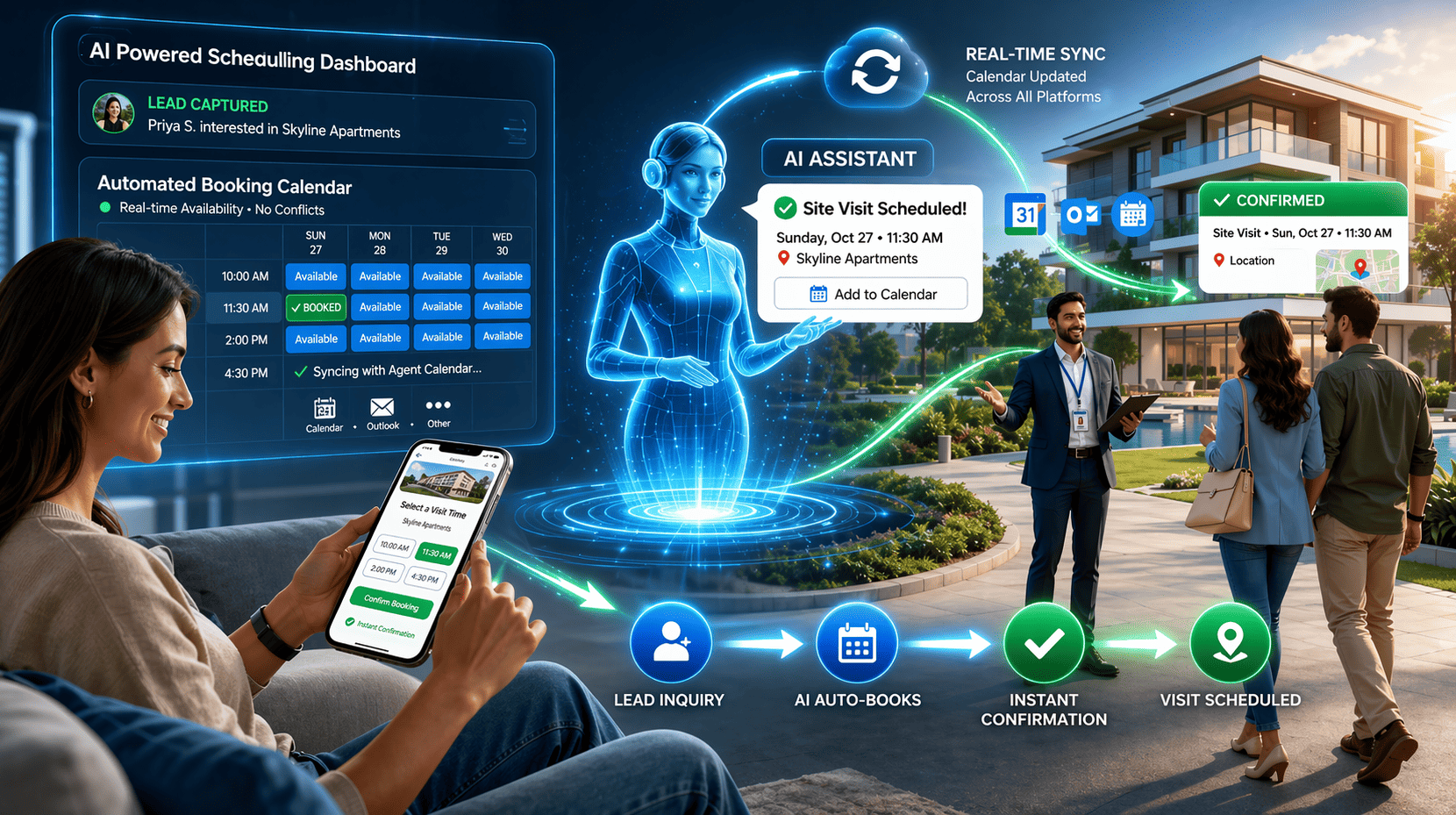
3. Deterministic Scheduling and Logistics
Once intent is verified, the system executes a calendar coordination protocol. This is not passive. The orchestration layer queries the real-time availability of on-site sales directors, maps the prospect's availability, and executes a calendar API integration (e.g., Microsoft Graph or Google Workspace).
More importantly, it manages the logistical variables. If a prospect is traveling from a high-density urban center, the system calculates drive times via spatial APIs and suggests optimal visitation windows to avoid local traffic bottlenecks, heavily reducing friction.
4. Dynamic Pre-Visit Nurture
The window between scheduling and the actual visit is where the highest percentage of drop-offs occur. Autonomous systems mitigate this through sequenced API calls to communication infrastructure (like Twilio or WhatsApp Business APIs). The system programmatically generates and delivers personalized micro-sites or AR-rendered unit walk-throughs specific to the floor plan the prospect discussed during the qualification phase.
"Site visit automation is the transition from reactive human follow-up to proactive, algorithmic state management."
─
The Infrastructure of Automation
Deploying this architecture requires moving beyond off-the-shelf CRM capabilities. Generalized SaaS platforms lack the deterministic execution required for multi-modal communication.
Technical leaders must prioritize an API-first middleware layer. This orchestration layer - often built on cloud-native infrastructure like AWS Step Functions or custom Python-based Directed Acyclic Graphs (DAGs) - acts as the central nervous system. It listens for state changes in the CRM, triggers the required generative AI models for communication, parses the user's natural language response, and executes the subsequent database update.
This decoupling of the interface (WhatsApp, SMS, Voice) from the logic layer ensures that as communication protocols evolve, the core automation engine remains intact.
─
Mitigating the "No-Show" Matrix
Predictive analytics must be integrated directly into the scheduling pipeline. By analyzing historical transaction data, an enterprise can train classification models to identify high-flight-risk leads before the scheduled visit.
If the algorithm flags a specific lead as having a high probability of a no-show (based on variables such as communication latency, time of day booked, or demographic cohorts), the orchestration layer autonomously shifts the nurture protocol. It might deploy an escalation agent to confirm the appointment via a secondary channel or trigger a personalized video message from the specific on-site sales director, mathematically engineering a higher show-up rate.
─
Strategic Questions for Leadership
Before initiating an overhaul of lead-to-visit workflows, real estate executives and technical architects must establish consensus on the following:
- What is our current median latency between initial lead ingestion and the first contextual engagement, and what is the exact P&L impact of that delay?
- Does our current CRM infrastructure allow for programmatic, bi-directional API communication with external generative AI models, or are we constrained by vendor limitations?
- Are we utilizing deterministic, enriched data to route leads to the appropriate human closer, or are we relying on inefficient round-robin distribution?
- Do we have a strict data governance framework to ensure our conversational agents are retrieving accurate, legally compliant property data during autonomous qualification?
More from the Journal

Why AI Automation Is No Longer Optional for Growing Businesses in 2026
Discover how AI automation is helping businesses reduce operational costs, improve customer experience, and scale faster without increasing headcount.